

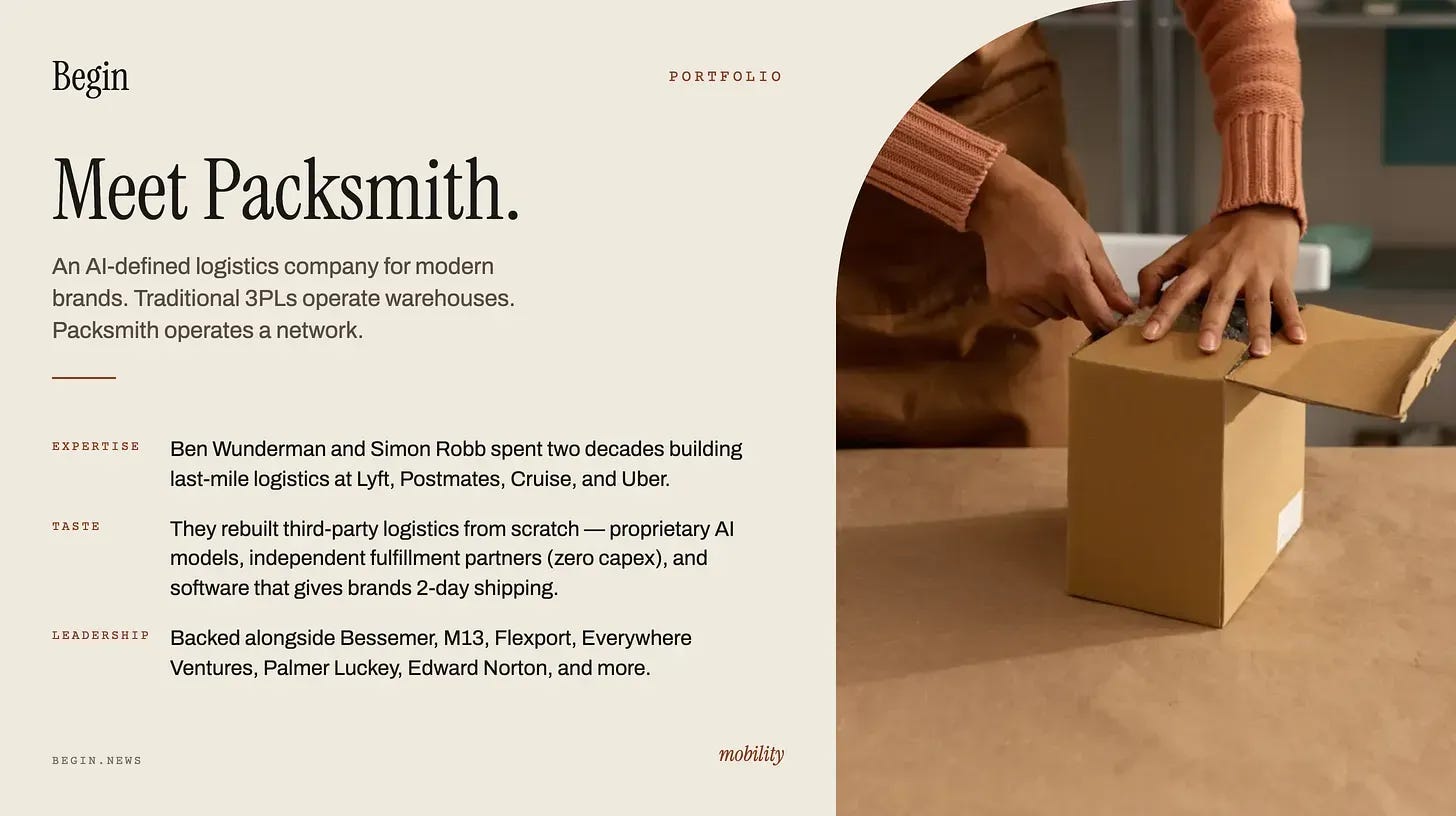
Ben Wunderman and Simon Robb are childhood friends turned co-founder duo, with a combined two decades in logistics and engineering. Ben ran market-launch teams at Lyft, Postmates, and Cruise. Simon is an engineer who built logistics platforms at Uber.
In today’s direct-to-consumer (DTC) world, brands want speedy delivery while maintaining a proprietary customer experience online and offline. There’s a reason you can’t get the newest Nike drop on Amazon – the platform forces customers to compete with everyone else. Shopify doesn’t, but the average shipping time is still 7-10 days.
When we first did our work on Packsmith, most startup DTC brands we spoke to were fulfilling orders from home or via mom-and-pop 3PLs running on spreadsheets. One brand told us they’d found their 3PL on Craigslist (literally.)
We were lucky to meet Ben in 2022. The initial question was simple: if last-mile delivery could be distributed, through technology and gig workers, why not packing and shipping?
Packsmith started by basically “Uber-ing” the third-party logistics (3PL) world. Individual “Packsmiths” coordinated with brands through the company’s mobile app, storing inventory in garages and spare shelf space, then boxing and shipping orders from home. Brands downloaded a free app from the Shopify store that helped visualize the complete inventory picture and surfaced ways to immediately cut costs and improve shipping speed.
The value prop worked. Packsmith cut shipping costs by 70% and shipping time to 2 days, routing orders more efficiently and closer to customers. What happened next is more interesting. As brands adopted Packsmith’s technology, so did their existing 3PLs and retail locations, turning Packsmith into a platform that benefits all parties – now including large customers like Nike and Hanes and ~2K fulfillment partners.
The contrarian in me loves Packsmith because it doesn’t fit neatly into a category. (Which means if you’re Ben, you’ve spent a lot of time educating investors.) It’s not really a marketplace. It’s not traditional SaaS, and it’s not gig-economy. Or maybe it’s all those things.
To us, Packsmith is a software-defined 3PL. Instead of running its own capital-intensive warehouses, it connects and coordinates a network of independent fulfillment partners through a single platform, letting brands integrate once to access a flexible national footprint. Traditional 3PLs operate warehouses. Packsmith operates a network. And underneath it all is Packsmith’s AI – six proprietary AI models trained on hundreds of thousands of real orders, driving extremely high fulfillment accuracy at scale.
We participated in Packsmith’s Pre-Seed, our first investment via SPV back in 2024 before we officially launched Begin — alongside Bessemer, Everywhere Ventures, M13, Climate Capital, Singularity Capital, Wave Function Ventures, Wedbush Ventures, Interplay, Team Ignite Ventures, Banana Capital, Flexport, Nomad Ventures, Karman Ventures, Alumni Ventures, and Trust Fund (Sophia Amoruso.) Other investors include Palmer Luckey, Edward Norton, Nucleus Ventures, Second Century Ventures, The Fund LA, Gallery Ventures, Animal Capital, and retail leaders from Nike, SKIMS, Procter & Gamble, and Patagonia.
To read our full research memo on Packsmith, plus access Pre-Seed → growth-stage investment opportunities, join our investor community.
This newsletter is for general informational purposes only and does not constitute an offer to sell, or a solicitation of an offer to buy, any security. It is written for the broader Begin Ventures community and is not directed to any particular investor or intended to imply that any recipient is already an investor in Begin Ventures. Any specific opportunity to invest in Begin Ventures Fund I is available only to verified accredited investors and only pursuant to Fund I's confidential offering documents, in reliance on Rule 506(c) of Regulation D. Begin Ventures Fund I is a 506(c) fund and may market to the general public. Begin Ventures also sponsors select special purpose vehicles ("SPVs") offered under Rule 506(b) of Regulation D to accredited investors with whom Begin Ventures has a pre-existing, substantive relationship established prior to any such offering; nothing in this letter should be construed as an offer or solicitation with respect to any SPV. Private investments are speculative, illiquid, and involve a high degree of risk, including risk of total loss. Past performance is not indicative of future results. This letter contains forward-looking statements that are inherently uncertain. Recipients should consult their own legal, tax, and financial advisors before making any investment decision.