

Last week while I was meditating, a quote from an investor I admire entered my inner chat. It’s one I’ve heard from a few different authors recently: “money is like water.”
I was thinking about this concept — money is like water — after attending a PEF event meant for founders who are post-exit and looking for their next venture.
A common theme amongst founders in the group was a desire to work on something with clear market pull. The kind of product-market fit that Mark Andreessen or Mike Maples Jr. would describe — where customers are requesting new features faster than you can build them and pulling product out of the team.
The meditation brought up a childhood memory I hadn’t thought about in years.
When I was in middle school, my dad took me fly fishing on the Penobscot River in Maine. Each day of the trip centered on a different fishing spot where Landlocked Salmon were supposedly abundant. On this particular day, we went to “the dam.”
My dad had an old boat, one he bought cheap and fixed up. Before the trip — an eight-hour drive — he tested the motor in a large bucket filled with water behind the house. It was running fine. But on that day, the motor wasn’t a match for the Penobscot’s current. Our boat got stuck and we couldn’t get upstream to the dam. We couldn’t tell if the boat’s motor was malfunctioning or if the river was just too strong.
I remember watching the other boats pass us embarrassed. I kept thinking: if we had more money, we’d have a better boat and we wouldn’t be stuck here. In retrospect, this was a rather entitled thought. That’s a different blog post.
We tried maybe ten times. Every time we’d make it up the river, the current would just pull us back down while the other boats watched. My dad was visibly pissed off. He never really swore, so he just kind of mumbled under his breath and made angry faces. Maybe he should have just said “fuck!” and released some tension. That’s also a different post.
This particular spot, on the river by the dam, was *where* to catch Landlocked Salmon. If you fish enough and you’re on the scene, you know where the spots are. My dad’s friends were all upstream already. We thought about packing it up and going back to camp.
After some discourse, we decided to drive downstream instead — a path the boat could actually handle. The river opened into a lake and we started trolling.
In case you’re unfamiliar with trolling, it’s a type of fishing where you cast your line off the back of the boat and just cruise. I never really liked fishing, and still don’t, so this lazy yet effective method worked fine for me. My dad probably chose it because mustering up energy for any other fly fishing technique was too much after the motor fiasco.
Like most childhood stories, the likelihood of revisionist history here is high. But this is exactly how I remember it. And as far as memories go, I’d say this is a core one.
About an hour into trolling, my dad was chilled out. We began chatting.
I don’t remember exactly what we were talking about, but I do remember it was one of my favorite dad chats. The lake was insanely beautiful. It felt like I was on the Discovery Channel and my dad was the narrator. This man loved nature, and I mean loved — daily morning walks in the woods, hunting trips that returned no game but a camera roll of photos, bird books, Cabela’s catalogs… he even planted some special kind of clover behind our house so deer would graze in our yard. (They did.) We talked about nature, and that day I “got it.”
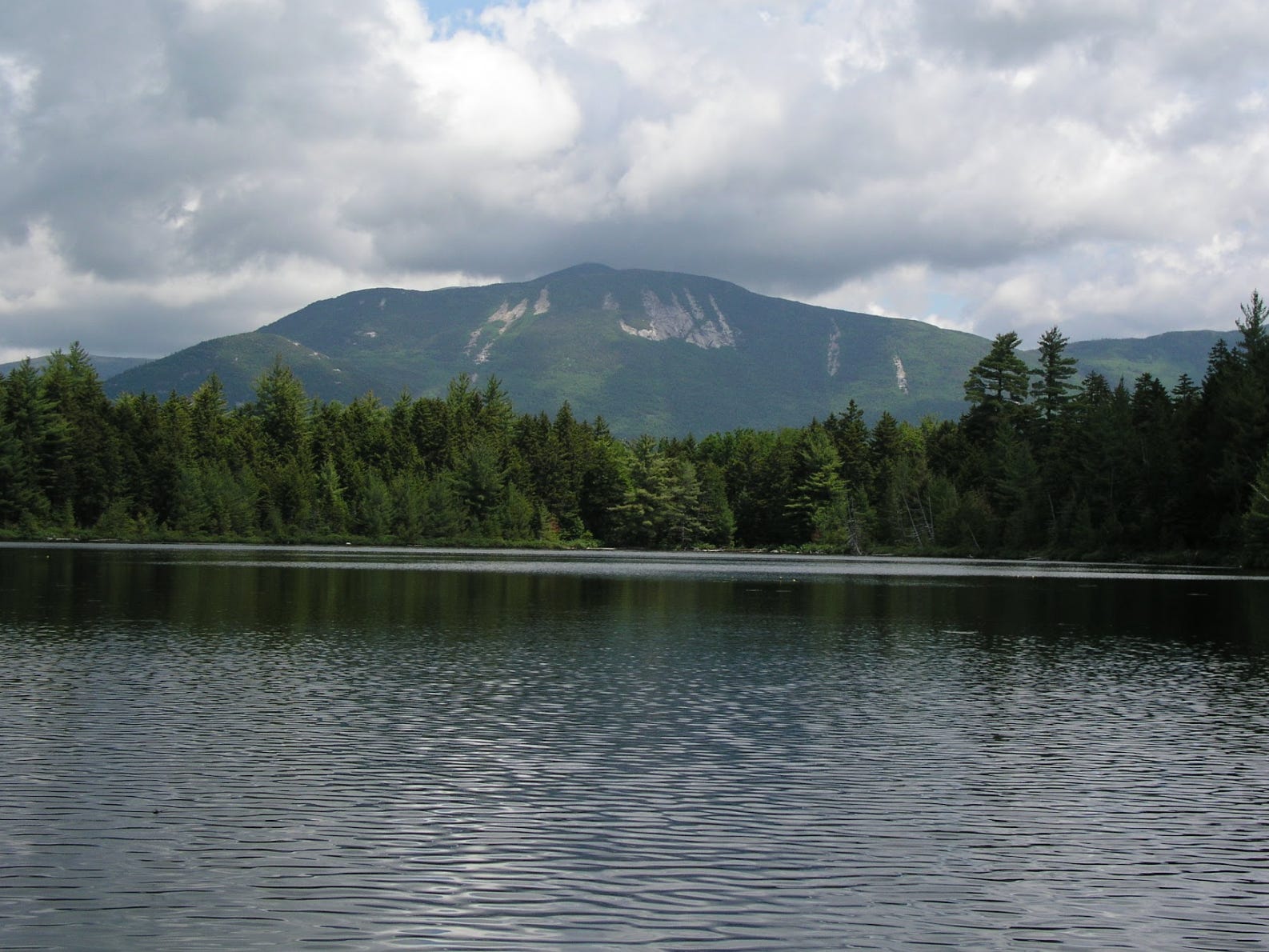
Here’s one of the many photos my dad took fishing in Maine.
Just as we were settling into nature, a bald eagle swooped down right in front of us, grabbed a salmon out of the water, and flew off. Some National Geographic shit.
As it happened, we looked at each other elated. There was like this spark of mutual understanding — like wow, glad we were here for that…
…And I kid you not, within moments of a bald eagle flying away with a fish in its talons, a loud “clunk” sounded from the boat’s rear. As if something stuck in the engine had now released, the boat kicked into high gear, speeding up 2x and surging forward.
What followed was laughter that’s hard to describe: true joy mixed with a kind-of mad scientist hysteria. Like… What just happened? How? The moment had a grounding effect of shared gratitude and connection. Plus, let’s face it, my dad was proud he wasn’t crazy about the motor. So there was a little “I told you so” thrown in there too.
So what’s my point? How does this relate to startups? What does this story have to do with a PEF event and my random morning meditation in Miami?
Trying and willing the boat upstream didn’t work. Our motor wasn’t strong enough, and there wasn’t much we could do differently in that moment. What did work was going downstream, where the river was already flowing and where our boat could easily travel.
The moment we stopped fighting the current and complaining about the boat, the boat worked. Plus, a fucking bald eagle — the only one I’ve ever seen IRL — literally showed us where the fish were. We had an entire pool of fish, all to ourselves, downstream.
It’s my educated observation, after working with hundreds of founders and being one, that many of you are building businesses trying to force an outcome. It’s usually based on some preconceived notion you have on how things are supposed to go.
When something doesn’t work, it doesn’t work. And it’s usually really clear that it’s not working. The problem is we fail to read the signals because we’re too tunnel-visioned on the outcome we want. We should be observing the reality of what’s happening instead.
In a river of horrible advice on this matter, pun totally intended, Sam Altman’s take is great. Burnout isn’t caused by working too much. It’s caused by working on things that aren’t working — like trying to get up-river with an old motor that can’t hang.
What I’d offer is this: stop focusing so much on how you want things to turnout. Or how you wish your customer would use your product. Instead, focus on what’s clearly, bright-as-day working. Observe reality for what it is.
Let’s call the things that clearly work rivers. Rivers in startups look like:
Markets that are obviously picking up speed
Technology inflections that make certain things possible that weren’t possible before
Features your customers tell you they want but you ignore*
*When you’re listening to customers through the lens of wanting things to look or go a certain way, it’s easy to miss what they actually say.
And then there are the boats. Boats in startups are:
Industries, products, or problems you uniquely understand based on your experience
Skills and tasks you’re actually good at and that give you energy
The team you can naturally build based on your existing network*
*I once asked an early Airbnb employee how they chose to design CX. Paraphrased, he said: “We hired our friend who knew CX. That’s how CX at Airbnb was designed.”
Boats are like what Warren Buffet famously calls your “circle of competence.” They are your unique competitive advantage, and they allow you to travel places that others aren’t seeking out — like a pool of fresh fish that others aren’t paying attention to.
Use the boat you’ve got. Follow the existing current.
That day on the Penobscot, we thought the goal was getting upstream. The spot by the dam where everyone else was fishing. We were actively frustrated when it didn’t work out.
But the current had other plans. By following it, we ended up in a place where no one else was fishing which worked particularly well for our boat. We caught plenty of fish in the lake using a method that took little to no effort. And the oddest part was that by doing so, our motor started working and we were able to cruise upstream.
I think I finally get this “money is like water” thing.
This is not where I thought you were going to go with "money is like water" but the message is exactly what I needed. Great read! Thanks for sharing your story and insights.
Enjoyed reading this. It’s great practice to be present and notice “what wants to happen”. Life always shows us, only if we could surrender enough to see it